·
·
Tarot
Subtitle
78 cards · symbolic system · interpretation-focused

Overview
Summary
Tarot is a structured language of symbols. Each card carries meaning on its own, but deeper understanding comes from relationship: how cards interact with each other, with their positions, and with the question being asked.
Tarot is best used for interpretation rather than certainty. It supports reflection, perspective, and clearer awareness of what is unfolding.
Introduction
Tarot is best understood as a system rather than a collection of isolated definitions. The cards are designed to work together, forming patterns that reflect inner experience, external circumstance, and the way the two shape each other.
A reading does not deliver a single fixed message. It creates a field of meaning where symbols, context, and attention reveal what matters most.
About
A standard tarot deck consists of 78 cards divided into two primary divisions: the Major Arcana and the Minor Arcana.
The Major Arcana tends to speak to larger themes and turning points. The Minor Arcana tends to describe day-to-day conditions, choices, and patterns in motion. Together, they form a complete symbolic framework that can be approached intuitively, analytically, or through a combination of both.
Tarot has been adapted and reinterpreted across centuries, but its core structure has remained recognizable across most traditions.
Interpretation
Symbols, structure, and meaning
Tarot meaning does not live in a single fixed definition. Each card carries meaning through several layers:
imagery
symbolic associations
place in the deck
relationship to other cards
position in a spread
Meaning emerges through interpretation rather than memorization. The same card can speak differently depending on context, intention, and placement within a reading.
Reflection, not prediction
Tarot is not treated here as instruction or certainty. It is a reflective language, a way to examine situations, perspectives, and possibilities.
Good reading is less about having the right keyword and more about asking better questions. What is being emphasized. What is changing. What is being asked of you.
History
Tarot originated in Europe as a playing card system and later developed into a tool for symbolic and interpretive use. Over time, its imagery absorbed cultural, philosophical, and psychological influences, contributing to the layered meanings readers work with today.
Historical traditions provide context, but modern practice often emphasizes personal relevance and situational clarity over strict lineage.
Organization and Structure
How the tarot deck is organized
The tarot deck is divided into two main groups, each serving a different role in interpretation.
Major Arcana (22 cards)
The Major Arcana points to larger themes, turning points, and long-range lessons. These cards often describe shifts in direction, identity, values, or meaning rather than immediate events.
The cards are numbered from The Fool (0) to The World (21). Some readers study this sequence as a learning model, but readings do not require a strict linear path.
Minor Arcana (56 cards)
The Minor Arcana reflects everyday experience and recurring patterns. It shows how larger themes play out through conditions, choices, and responses.
It is organized by:
four suits: Pentacles, Cups, Swords, and Wands
ranks: numbered cards (Ace through Ten) and court cards (Page, Knight, Queen, King)
Suit shows the domain of experience. Rank shows stage or expression. Together, they shape meaning.
Explore the Concepts
Structure and symbolism in Tarot
Tarot concepts explain how the deck is organized and how meaning is shaped through arcana, suits, and ranks. These ideas provide the framework that links individual cards into a unified system.

Major Arcana
Universal archetypes and enduring themes that shape meaning, identity, and perspective.

Minor Arcana
Situational patterns and daily experiences shaped by context, choice, and response.

Pentacles
Concerns material life, work, resources, health, and long-term stability.
Cups
Concerns emotions, relationships, intuition, and inner experience.
Swords
Concerns thought, communication, truth, and decision-making.

Wands
Concerns creativity, motivation, action, and personal drive.

Numbered Cards
Describe how situations develop through stages, from beginnings to completion.

Court Cards
Describe how energy is expressed through roles, behavior, and personal approach.
Explore the Cards
The 78 Cards of the Tarot
Each tarot card represents a distinct symbolic pattern. Some cards point to larger themes and turning points, while others reflect everyday conditions and responses.
Exploring cards individually reveals nuance. Exploring them together reveals structure.

The Fool
A 78-card symbolic system used for interpretation through Major and Minor Arcana.

The Magician
A 78-card symbolic system used for interpretation through Major and Minor Arcana.

The High Priestess
A 78-card symbolic system used for interpretation through Major and Minor Arcana.

The Empress
A 78-card symbolic system used for interpretation through Major and Minor Arcana.

The Emperor
A 78-card symbolic system used for interpretation through Major and Minor Arcana.

The Hierophant
A 78-card symbolic system used for interpretation through Major and Minor Arcana.

The Lovers
A 78-card symbolic system used for interpretation through Major and Minor Arcana.

The Chariot
A 78-card symbolic system used for interpretation through Major and Minor Arcana.

Strength
A 78-card symbolic system used for interpretation through Major and Minor Arcana.

The Hermit
A 78-card symbolic system used for interpretation through Major and Minor Arcana.

Wheel of Fortune
A 78-card symbolic system used for interpretation through Major and Minor Arcana.

Justice
A 78-card symbolic system used for interpretation through Major and Minor Arcana.

The Hanged Man
A 78-card symbolic system used for interpretation through Major and Minor Arcana.

Death
A 78-card symbolic system used for interpretation through Major and Minor Arcana.

Temperance
A 78-card symbolic system used for interpretation through Major and Minor Arcana.

The Devil
A 78-card symbolic system used for interpretation through Major and Minor Arcana.

The Tower
A 78-card symbolic system used for interpretation through Major and Minor Arcana.

The Star
A 78-card symbolic system used for interpretation through Major and Minor Arcana.

The Moon
A 78-card symbolic system used for interpretation through Major and Minor Arcana.

The Sun
A 78-card symbolic system used for interpretation through Major and Minor Arcana.

Judgement
A 78-card symbolic system used for interpretation through Major and Minor Arcana.

The World
A 78-card symbolic system used for interpretation through Major and Minor Arcana.

Ace of Pentacles
A 78-card symbolic system used for interpretation through Major and Minor Arcana.

Two of Pentacles
A 78-card symbolic system used for interpretation through Major and Minor Arcana.

Three of Pentacles
A 78-card symbolic system used for interpretation through Major and Minor Arcana.

Four of Pentacles
A 78-card symbolic system used for interpretation through Major and Minor Arcana.

Five of Pentacles
A 78-card symbolic system used for interpretation through Major and Minor Arcana.

Six of Pentacles
A 78-card symbolic system used for interpretation through Major and Minor Arcana.

Seven of Pentacles
A 78-card symbolic system used for interpretation through Major and Minor Arcana.

Eight of Pentacles
A 78-card symbolic system used for interpretation through Major and Minor Arcana.

Nine of Pentacles
A 78-card symbolic system used for interpretation through Major and Minor Arcana.

Ten of Pentacles
A 78-card symbolic system used for interpretation through Major and Minor Arcana.
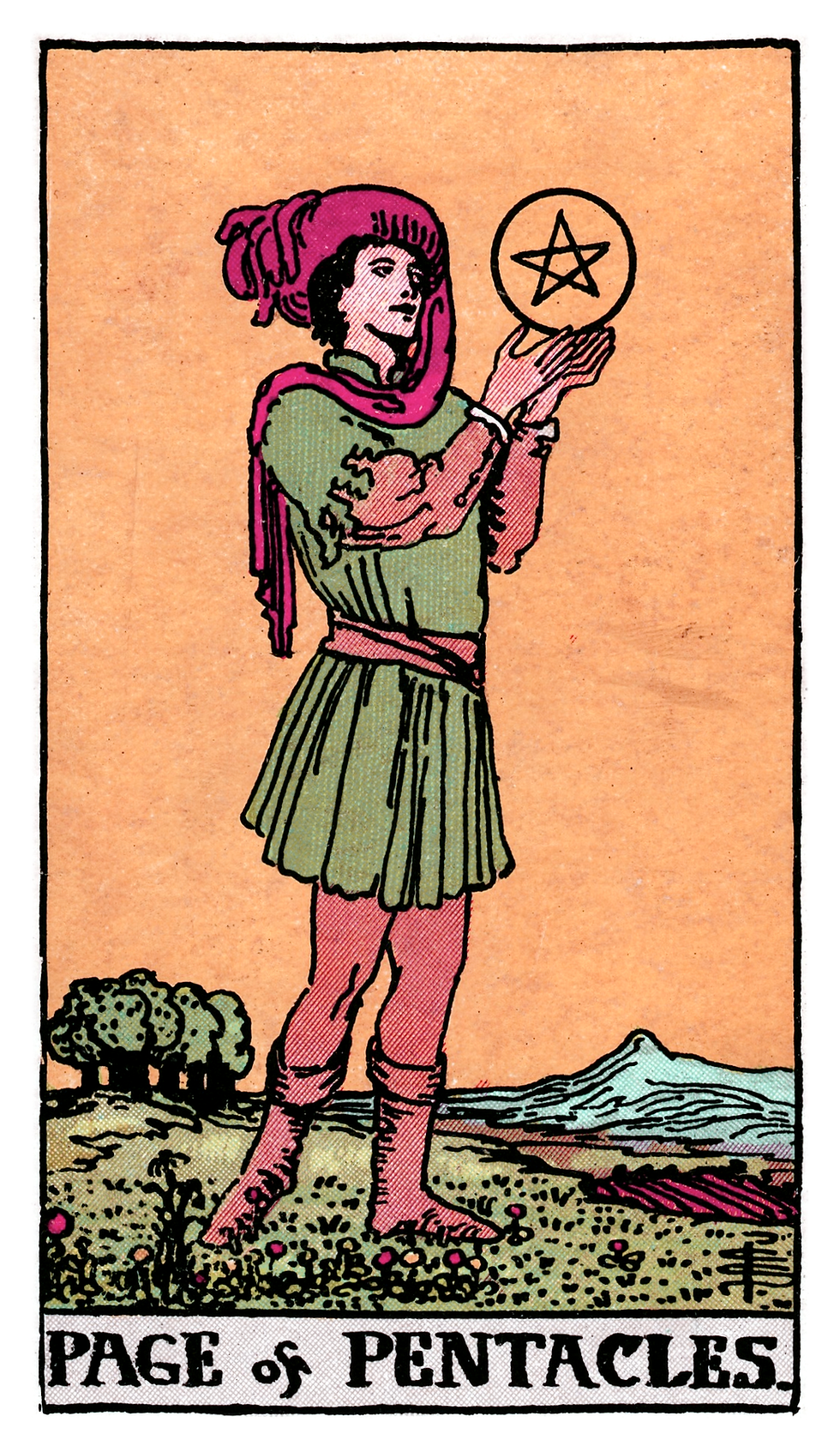
Page of Pentacles
A 78-card symbolic system used for interpretation through Major and Minor Arcana.

Knight of Pentacles
A 78-card symbolic system used for interpretation through Major and Minor Arcana.

Queen of Pentacles
A 78-card symbolic system used for interpretation through Major and Minor Arcana.

King of Pentacles
A 78-card symbolic system used for interpretation through Major and Minor Arcana.

Ace of Cups
A 78-card symbolic system used for interpretation through Major and Minor Arcana.

Two of Cups
A 78-card symbolic system used for interpretation through Major and Minor Arcana.

Three of Cups
A 78-card symbolic system used for interpretation through Major and Minor Arcana.

Four of Cups
A 78-card symbolic system used for interpretation through Major and Minor Arcana.

Five of Cups
A 78-card symbolic system used for interpretation through Major and Minor Arcana.

Six of Cups
A 78-card symbolic system used for interpretation through Major and Minor Arcana.

Seven of Cups
A 78-card symbolic system used for interpretation through Major and Minor Arcana.

Eight of Cups
A 78-card symbolic system used for interpretation through Major and Minor Arcana.

Nine of Cups
A 78-card symbolic system used for interpretation through Major and Minor Arcana.

Ten of Cups
A 78-card symbolic system used for interpretation through Major and Minor Arcana.

Page of Cups
A 78-card symbolic system used for interpretation through Major and Minor Arcana.

Knight of Cups
A 78-card symbolic system used for interpretation through Major and Minor Arcana.

Queen of Cups
A 78-card symbolic system used for interpretation through Major and Minor Arcana.

King of Cups
A 78-card symbolic system used for interpretation through Major and Minor Arcana.

Ace of Swords
A 78-card symbolic system used for interpretation through Major and Minor Arcana.

Two of Swords
A 78-card symbolic system used for interpretation through Major and Minor Arcana.

Three of Swords
A 78-card symbolic system used for interpretation through Major and Minor Arcana.

Four of Swords
A 78-card symbolic system used for interpretation through Major and Minor Arcana.

Five of Swords
A 78-card symbolic system used for interpretation through Major and Minor Arcana.

Six of Swords
A 78-card symbolic system used for interpretation through Major and Minor Arcana.

Seven of Swords
A 78-card symbolic system used for interpretation through Major and Minor Arcana.
Eight of Swords
A 78-card symbolic system used for interpretation through Major and Minor Arcana.

Nine of Swords
A 78-card symbolic system used for interpretation through Major and Minor Arcana.

Ten of Swords
A 78-card symbolic system used for interpretation through Major and Minor Arcana.

Page of Swords
A 78-card symbolic system used for interpretation through Major and Minor Arcana.

Knight of Swords
A 78-card symbolic system used for interpretation through Major and Minor Arcana.

Queen of Swords
A 78-card symbolic system used for interpretation through Major and Minor Arcana.

King of Swords
A 78-card symbolic system used for interpretation through Major and Minor Arcana.

Ace of Wands
A 78-card symbolic system used for interpretation through Major and Minor Arcana.

Two of Wands
A 78-card symbolic system used for interpretation through Major and Minor Arcana.

Three of Wands
A 78-card symbolic system used for interpretation through Major and Minor Arcana.

Four of Wands
A 78-card symbolic system used for interpretation through Major and Minor Arcana.

Five of Wands
A 78-card symbolic system used for interpretation through Major and Minor Arcana.

Six of Wands
A 78-card symbolic system used for interpretation through Major and Minor Arcana.

Seven of Wands
A 78-card symbolic system used for interpretation through Major and Minor Arcana.

Eight of Wands
A 78-card symbolic system used for interpretation through Major and Minor Arcana.

Nine of Wands
A 78-card symbolic system used for interpretation through Major and Minor Arcana.

Ten of Wands
A 78-card symbolic system used for interpretation through Major and Minor Arcana.

Page of Wands
A 78-card symbolic system used for interpretation through Major and Minor Arcana.

Knight of Wands
A 78-card symbolic system used for interpretation through Major and Minor Arcana.

Queen of Wands
A 78-card symbolic system used for interpretation through Major and Minor Arcana.

King of Wands
A 78-card symbolic system used for interpretation through Major and Minor Arcana.
More About
Tarot can be approached intellectually, intuitively, or through lived experience. There is no single correct method, only practices that fit different readers and different questions.
Over time, the best learning comes from reading repeatedly, noticing patterns, and letting meaning deepen through use.
Conclusion
Tarot is a system of meaning shaped by relationship, context, and interpretation. Whether you draw one card or read an entire spread, it invites inquiry rather than certainty.
It is most useful when it helps you see clearly, choose honestly, and respond with intention.
Editorial
These fields control how this item appears in lists (Snippet/Teaser) and in search engines (Meta Description). Visible only to Editors.
Snippet
A short line used when the surrounding context already explains what this is. Aim for a quick statement, not a full description.
A 78-card symbolic system used for interpretation through Major and Minor Arcana.
Teaser
The default preview text for repeaters, browse pages, and internal search. Write 1–2 sentences that stand alone and make someone want to click.
Tarot is a structured language of symbols. Learn how the deck is organized, and how meaning emerges through context, relationship, and interpretation.
Meta Description
Used for search engines and social previews. Summarize the page in ~150–160 characters, include the key term naturally, and avoid quotes or line breaks.
Tarot meaning and structure: a 78-card symbolic system divided into Major and Minor Arcana. Learn how tarot works through symbols, context, and interpretation.